Many of our clients own business assets or personal property that have appreciated in value and struggle with ways to sell these assets without triggering immediate capital gains taxes. The good news is, there is a way to defer these taxes by using a 1031 Exchange.
If you've ever owned real estate for business purposes or physical property as an investment, you're probably well aware that these assets can leave you susceptible to large capital gains taxes as they appreciate in value. Perhaps you own an apartment building and rent out the units for additional income or maybe you own a plot of farm land. Whenever you sell these items, like any taxable investment, you could be subjected to capital gains taxes for any appreciation above your original cost basis. Although, if your intent is to sell your property and exchange it for a similar replacement, the IRS allows for the delay in recognizing any capital gains given certain parameters are met. Known as a "1031 Exchange," the Internal Revenue Code allows for a Like-Kind exchange of properties to delay recognition of any capital gains taxes if the property is held either for investment or as a business asset.
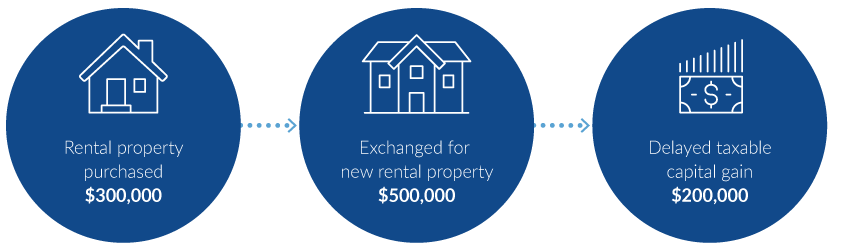
As an example, if you had purchased a rental property for $300,000 ten years ago and today it is worth $500,000, you would be responsible for $200,000 in capital gains taxes if you sold it outright.

However, if you instead sold the property and purchased another for rental purposes within 180 days of the original sale, the IRS would allow you to delay paying capital gains taxes on the $200,000 appreciation until you subsequently sell the new property. Doing so could push a potentially large tax burden off until a more favorable time for you or even pass along tax-free to your heirs with a step-up in basis upon your death.
This rule however, is not as simple as it seems as there are certain parameters that must be met and factors that can disqualify portions of a gain from deferral. Most notable among these is the strict time constraints that must be met. After selling the original property, the taxpayer must first identify a replacement property within 45 days of sale and subsequently complete the purchase of the replacement property within 180 days. Missing either of these deadlines will nullify any deferral and the taxpayer will be required to recognize the gains.
Additionally, portions of any realized gains can be excluded from deferral if the exchange is not equal. An exchange where additional cash or property is also included, and/or where debts are passed between parties could make the transaction unequal, thereby disqualifying the difference from exclusion. The amount of this unequal exchange is known as Boot.� In our previous example, consider if there was an outstanding mortgage of $100,000 on the property that you had exchanged. In this case, the IRS considers the exchange of the mortgage as an additional credit to you (known as "receiving boot") thereby reducing the amount of capital gains you can delay. You would thus be responsible for paying $100,000 in capital gains but still be allowed to delay the remaining $100,000.

While this can be a very useful allowance by the IRS, it is not without its rules, restrictions, and tax pitfalls. As such, this type of maneuvering can only be undertaken with the use of a "Qualified Intermediary" such as a lawyer, accountant, or title company. These third parties not only provide professional advice but also hold sales proceeds in escrow and subsequently use them to purchase your new property. Doing so helps the taxpayer to avoid coming into contact with sales proceeds which would invalidate the deferral.
It's also worth pointing out what assets are not afforded this treatment. Personal use assets (such as a primary home or an automobile), inventory, securities (stocks and bonds), an exchange of foreign real estate for domestic real estate, and partnership interests are just a few that don't qualify. Alternatively, the IRS has a fairly loose interpretation of what represents a Like-Kind� property. According to the IRS, the exchange must be of properties that are similar enough, matching in nature, class, and/or character.
This combination of strict guidelines but loose interpretations makes it all the more important to work closely with your accountant and tax preparer to maintain accurate records of your cost basis (including any adjustments) while staying within the bounds of the law.
If you are considering selling an asset and purchasing a replacement, take a moment to speak with your Mesirow representative to see if you may be eligible for this unique tax consideration.
Published March 2026
Mesirow Wealth Management is a division of Mesirow Financial Investment Management, Inc., an SEC-registered investment advisor. Securities offered through Mesirow Financial, Inc., member FINRA, SIPC. Advisory Fees are described in Mesirow Financial Investment Management Inc.’s Part 2A of the Form ADV.