
Suddenly, the world is taking cryptocurrencies seriously. Since July 2024, the market capitalization of stablecoins, a type of cryptocurrency, has grown 76% from $161 billion to over $280 billion (as of August 27, 2025).
Giant retailers such as Walmart and Amazon are considering issuing their own stablecoins, and President Trump signed stablecoin legislation in July 2025 to regulate the industry. China, which previously banned cryptocurrencies, is worried that a dollar-backed stablecoin will further entrench the US dollar as the world's dominant currency, and it's scrambling to catch up.
Cryptocurrencies are notoriously susceptible to wild swings in price. That volatility lessens cryptocurrencies appeal for use in payments. Stablecoins reduce that volatility by fixing, or pegging, their value to that of another asset such as a currency or commodity. The peg assures users that the stablecoin's value will remain steady, eliminating fears about sharp changes in cryptocurrency valuations.
Stablecoins can be pegged to a single asset or a combination of assets. Table 1 presents types of stablecoins, how they maintain stability, and examples of stablecoins within the category.
Stablecoin market value is approximately $282 billion or about 7% % of total cryptocurrency value of $3.97 trillion. There are almost 350 stablecoins, but five stablecoins represent nearly 92% of the cryptocurrency category value (Table 2). Given the combined value of Tether and USDC, currency-backed stablecoins dominate the cryptocurrency market.
| Stablecoin | Backing | Value (billions) | % of stablecoin value | ||
 |
Tether | USDT | Currencies, mostly US dollar | 167.1 | 59.7% |
 |
USDC | USDC | US dollar | 66.9 | 23.9% |
 |
Ethena USDe | USDE | Cryptocurrencies; synthetic dollar | 11.8 | 4.2% |
 |
USDS | USDS | Mix of US Treasuries, overnight repos and cash | 7.8 | 2.8% |
 |
Dai | DAI | Cryptocurrencies | 42 | 1.5% |
| 92.2% | |||||
| Note: Value is market capitalization | Source: https://www.coingecko.com/en/categories/stablecoins as of August 22, 2025 12:30 pm PT | |||||
Things are serious – and terrifying, as President Reagan intimated – when Congress gets involved. In mid-July 2025, the Senate and House of Representatives passed the Guiding and Establishing National Innovation for US Stablecoins (GENIUS) Act, a regulatory framework for stablecoins. It provides for reserve requirements including reporting, redemption policies and anti-money laundering.
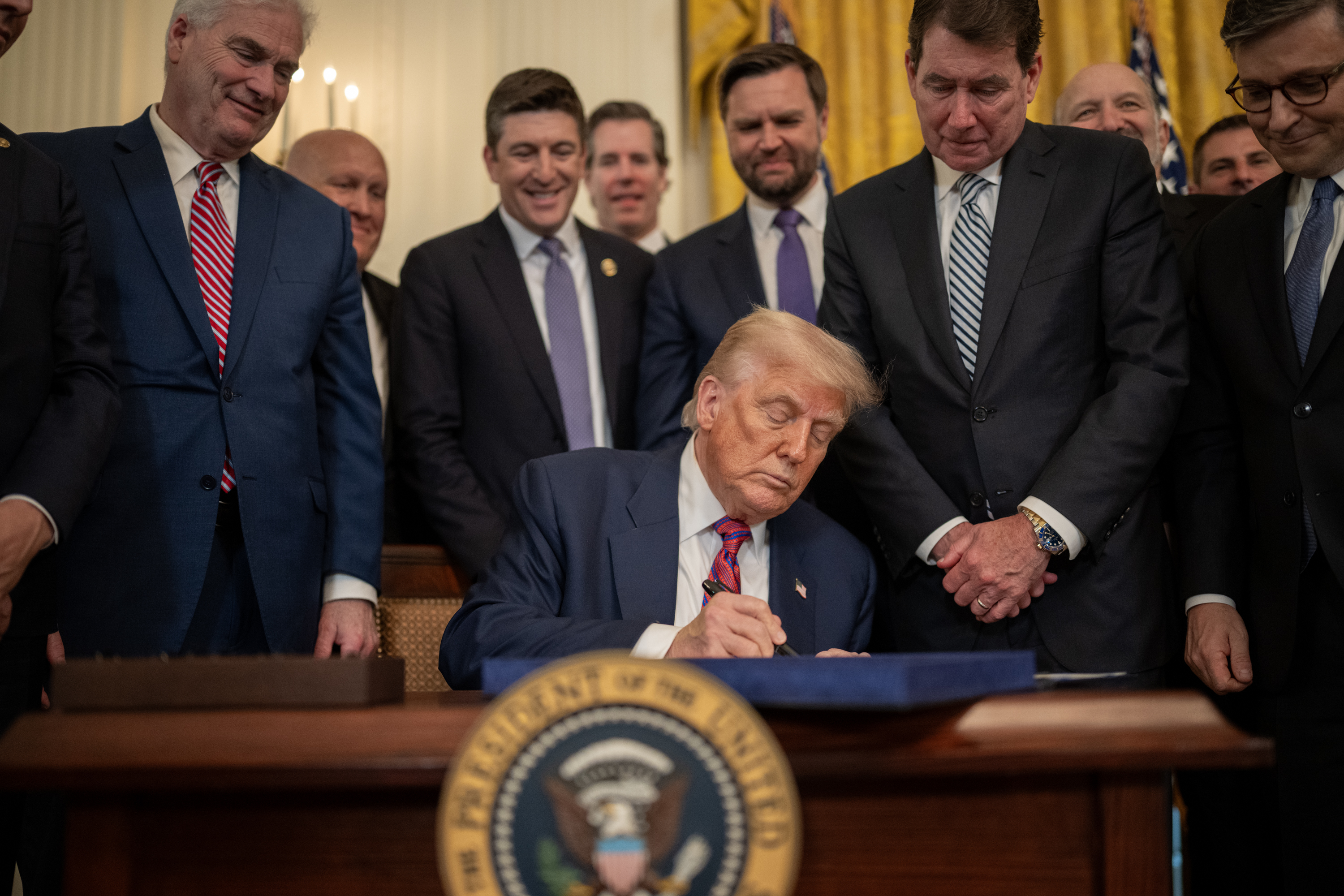
Passed with strong bipartisan support, the President signed the act on 18 July 2025. The act offers clear guidelines and certainty to the stablecoin industry, necessary ingredients for growth and leadership in a globally competitive industry.
Stablecoin development is emerging from major banks including JP Morgan Chase, Bank of America, Citigroup and Wells Fargo which are discussing a joint stablecoin venture. The banks reckon that stablecoins will speed transactions, make cross-border payments easier and less costly, and will keep the banks competitive with cryptocurrency firms that dominate the stablecoin market.
Competition might also come from a surprising part of the business world – non-financial firms such as Amazon and Walmart plus other businesses like Expedia and airlines. Tired of paying high credit card fees to Mastercard and Visa, these businesses are evaluating whether to issue individual stablecoins or join a stablecoin consortium.
It's understandable to want to ditch the credit card companies, but it's expensive to replicate the features that those firms have developed. Take widespread use – most people have at least one card and nearly every merchant accepts them. There are other advantages too: It's easy to extend credit, make payments and manage the financial relationship between merchant and customer.
Credit cards are a profitable business. You might reasonably expect, then, that credit card companies would strenuously resist stablecoins. Instead, Mastercard and Visa are embracing virtual payments. The card companies support partners offering stablecoin-funded cards resulting in a cryptocurrency transaction process for merchant and customer that's as familiar as transactions using traditional payment methods.
An important part of those traditional methods is passing out rewards to card holders. With stablecoins, rewards can continue because stablecoin issuers keep cash or government securities to back their coins. Interest from that cash or bills can be used to fund rewards.
Prospects for stablecoins seems unlimited. Treasury Secretary Scott Bessent is enthusiastic when discussing potential holdings of Treasuries by stablecoin issuers. In an X post, he wrote that the stablecoins could grow to $3.7 trillion by the end of the decade, driving demand for treasuries, lowering government borrowing costs and helping to rein in the national debt. It's a win for the private sector, consumers, and the US Treasury, according to the Secretary.
Morgan Stanley, an investment bank, has lofty estimates for Treasuries needed as collateral for stablecoins. Morgan Stanley estimates that $200 billion of Treasury bills are held as reserves by stablecoin issuers. Depending on growth trajectories, stablecoin issuers could hold $400 billion to $1.6 trillion in Treasuries within a couple of years.
Stablecoin development in other countries are in various stages. Some global regions have a head start in the stablecoin payments race while others, such as China, lag. Europe is in front with its Markets in Crypto-Assets regulations for governing cryptocurrencies including stablecoins. Latin America excels with infrastructure readiness while Asia's focus is to use its infrastructure to focus on market expansion.
China lags far behind. Worried about capital flight and financial instability, it has banned all cryptocurrency activities. But worries about the US and others getting too far ahead in stablecoin payments has prompted China to issue a yuan-backed stablecoin. Capital controls and cryptocurrency prohibition complicate adoption and development, but the threat of being just a role player in global payments is spurring action.
Stablecoins have intriguing virtues and benefits such as low-cost and faster transactions, but investors and users may be overlooking stablecoins' troubling risks. While steady value is the goal, it's good to keep in mind the collapse of TerraUSD, an algorithmic stablecoin which broke its peg to the dollar in May 2022. The collapse of TerraUSD and its sister stablecoin LUNA sent shockwaves through the cryptocurrency community.
A robust regulatory framework may prevent future collapses, but rules and regulations can lag technological developments. If stablecoins become integral to global payment processes and have large holdings of US treasuries as backing, a meltdown of one or more coins could threaten the stability of the global financial system.
Connect with us to learn more about Mesirow Currency solutions

Customized solutions to manage unrewarded currency risk in international portfolios.

Strategies that aim to profit from short and medium-term moves in the currency market.

Trading solution for asset managers and owners with focus on reducing transaction costs, improving transparency and enhancing efficiency.
The information contained herein should not be construed as a recommendation to purchase or sell any particular security or investment vehicle offered by Mesirow . The information included has been obtained from sources believed to be reliable, but is not necessarily complete and its accuracy cannot be guaranteed. Any opinions expressed are subject to change without notice. Mesirow Financial Investment Management, Inc. and its affiliated companies and/or individuals may, from time to time, own, have long or short positions in, or options on, or act as a market maker in, any securities discussed herein and may also perform financial advisory or investment banking services for those companies. It should not be assumed that any recommendations incorporated herein will be profitable or will equal past performance. Any stated performance results include the reinvestment of dividends and other earnings. Investment management services offered by Mesirow Financial Investment Management, Inc., an SEC-registered investment advisor.