
Currencies can be confusing, but they aren't difficult to understand when you know the basics. To help clear up the confusion, Mesirow will post articles throughout 2025 that cover key topics about currency basics. This series will include explanations on how currencies are quoted (topic of this article), how countries manage their national currencies and the essentials of currency hedging.
Currencies, or foreign exchange, often reflect, and sometimes warn of, geopolitical and economic events. Understanding foreign exchange can offer valuable insights into global affairs.
Let's dive in.
Consider this headline:
"Russian ruble falls from 92 to 98"
At first glance, this might seem backward. Shouldn't it say the ruble rises from 92 to 98? Or falls from 98 to 92? The confusion arises from how currency exchange rates are quoted.
Let's clarify.
A currency quote typically has two components: the base currency, the quote currency and the exchange rate. These are identified using standardized three-letter codes established by the International Organization for Standardization (ISO). For example:
These codes combine the two-letter ISO country code with the first letter of the currency name. For instance, US + D(ollar) = USD.
However, there are exceptions such as the Russian ruble. In 1998, Russia redenominated its currency, replacing 1,000 old rubles (RUR) with one new ruble (RUB). The ISO code was updated accordingly.
The exchange rate shows how much of the quote currency is equivalent to one unit of the base currency (Figure 1). For example, if the US dollar – Russian ruble exchange rate is 98.1022, it means 1 USD can be exchanged for 98.1022 rubles. Typically, exchange rates are quoted to four decimal places. However, exceptions exist – for instance some traders may use five places, and the Japanese yen is usually quoted to two decimal places. Media reports often drop the decimal portion for clarity.
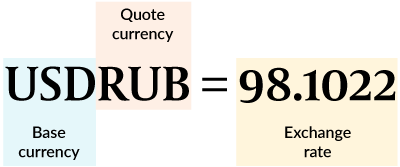
Translation: One US dollar can be exchanged for 98.1022 Russian rubles
If an exchange rate increases, the base currency is said to be strengthening. If it decreases, the base currency is weakening. Because currency pairs reflect the relationship between two currencies, when one currency strengthens, the other weakens.
For example:
Let's revisit the headline: "Russian ruble falls from 92 to 98." On the surface, it may seem like the ruble is rising, but the confusion stems from a subtle detail.
The journalist is indirectly writing about movements in the base currency – the US dollar – but is reporting on the quote currency, the ruble. Yesterday, a dollar was worth 92 rubles; today it's worth 98 rubles. The US dollar is strengthening and, conversely, the Russian ruble is weakening (Table 1 and Figure 2); it's the ruble weakness that the journalist wants you to note.
A clearer headline might read: "The dollar rises from 92 to 98 rubles." The journalist might continue by describing why a stronger dollar / weaker ruble is important to Russian citizens and businesses: a weaker ruble means imports are more expensive, contributing to inflation.
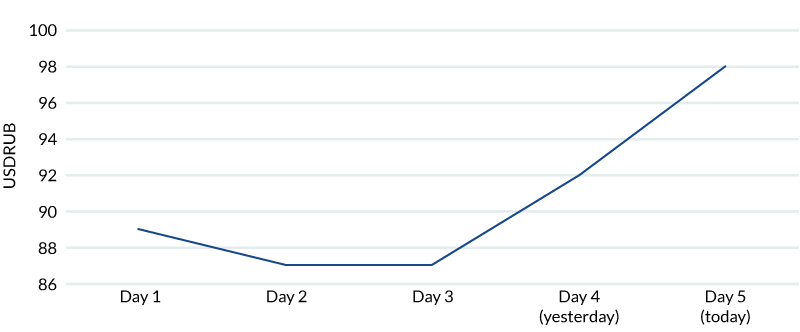
'The dollar rose from yesterday's rate of 92 to 98' and 'The ruble fell to 98 from yesterday's rate of 92' are equivalent statements.
Understanding currency quotes is the first step in navigating the confusing world of foreign exchange. By learning how exchange rates are presented and what they signify, you'll gain a clearer view of the economic trends and market forces shaping currency values.
Check back for more insights as we explore the world of currencies and their role in the global economy.
Connect with us to learn more about Mesirow Currency solutions

Customized solutions to manage unrewarded currency risk in international portfolios.

Strategies that aim to profit from short and medium-term moves in the currency market.

Trading solution for asset managers and owners with focus on reducing transaction costs, improving transparency and enhancing efficiency.
The information contained herein should not be construed as a recommendation to purchase or sell any particular security or investment vehicle offered by Mesirow . The information included has been obtained from sources believed to be reliable, but is not necessarily complete and its accuracy cannot be guaranteed. Any opinions expressed are subject to change without notice. Mesirow Financial Investment Management, Inc. and its affiliated companies and/or individuals may, from time to time, own, have long or short positions in, or options on, or act as a market maker in, any securities discussed herein and may also perform financial advisory or investment banking services for those companies. It should not be assumed that any recommendations incorporated herein will be profitable or will equal past performance. Any stated performance results include the reinvestment of dividends and other earnings. Investment management services offered by Mesirow Financial Investment Management, Inc., an SEC-registered investment advisor.