
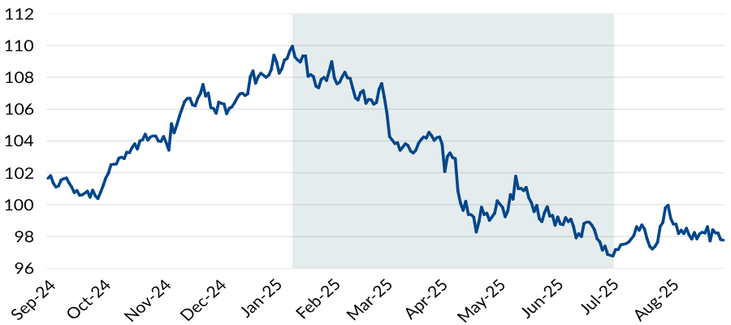
Since September 2024, the US dollar's value has followed a wild and bumpy path, reaching a peak in January 2025 on post-election optimism surrounding tax reform and deregulation, but then declining roughly 12% by early July (Figure 1).
In fact, a drop this dramatic for the first half of the year hadn't been seen since 1973 (when the US was in the midst of the Watergate scandal). The dollar bore the brunt of shifting sentiment around trade policy, concerns about reserve currency status, and rising debt levels.
Currency futures are designed for such volatile environments. These contracts allow market participants to manage currency risk or speculate on exchange rate movements by agreeing today to exchange currencies at a future date and predetermined rate.
Currency futures are derivative instruments – contracts whose value is derived from an underlying asset, in this case, a currency pair. The spot exchange rate reflects the current value of one currency relative to another (e.g., €1 = $1.1685).
Currency futures are standardized in terms of contract size, currency pair, expiration date, and minimum price fluctuation. For example, a standard euro futures contract represents €125,000, expires quarterly, and has a minimum price movement equivalent to $6.25.
These contracts are traded on centralized exchanges, which serve two essential functions: they provide transparent pricing by publishing all trades, and they act as the counterparty to every transaction. This structure enhances market integrity and ensures that contractual obligations are met.
While futures exchanges operate globally, the Chicago Mercantile Exchange (CME) is the dominant futures venue (Figure 2).
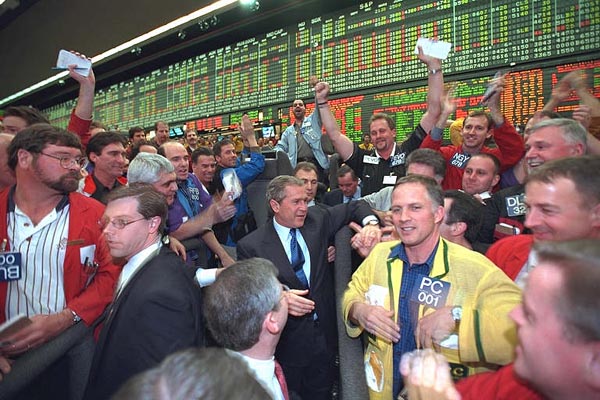
CME offers a vast array of futures (e.g. agricultural and energy commodities) and includes a broad array of currency pairs. The CME competes with Atlanta-based Intercontinental Exchange (ICE), Eurex in Europe, and Singapore Exchange (SGX) in Asian markets. Each exchange provides standardized contracts and transparent pricing, with trading available nearly 24 hours a day (see Table 1).
The exchanges offer trading platforms, but traders may also access futures markets through platforms such as Interactive Brokers, E*TRADE, or TradeStation, depending on their experience, trading requirements and analytical needs.
If futures are standard, forwards are custom. Both describe a later date currency exchange, but forwards allow for tailored amounts, dates, and collateral terms.
Futures trade on exchanges; forwards trade over the counter (OTC), often via dealer networks. OTC trading can fragment liquidity and obscure pricing, while futures exchanges offer transparency and centralized pricing. Table 2 presents characteristics of futures and forwards.
Currency futures pricing is based on the spot exchange rate and the interest rate differential between the two currencies. The difference between the spot and futures price – known as the basis – can be positive or negative. As the contract approaches expiration, the futures price converges toward the spot rate due to the declining time value of money.
Pricing is governed by the covered interest rate parity equation:
F = S * (1+ ibc) / (1+iqc) where F is the futures price, S is the spot rate, ibc is the base currency interest rate, and iqc is the quote currency interest rate.
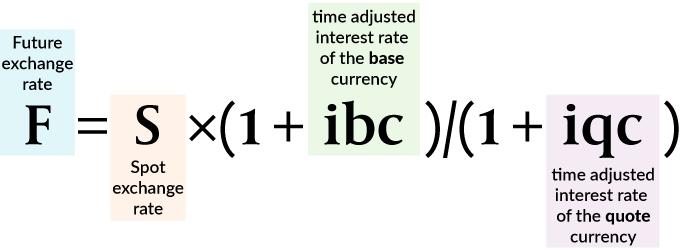
See this spot and forwards article for more information about base and quote currencies and an example using values in the CIRP equation.
Most currency futures are cash settled. If you don't want to take delivery (like a truckload of wheat), you simply close out the contract before expiration and settle the difference in cash. That's ideal for traders focused on price movement rather than physical exchange.
Currency futures are primarily used for hedging and speculative purposes.
Corporations engaged in international trade often hedge against exchange rate fluctuations to protect profit margins. For example, a European firm purchasing US oil may sell euros via futures to lock in the EUR/USD rate. If the euro depreciates, gains on the futures contract offset losses from the spot market transaction.
Speculators use currency futures to express views on exchange rate movements. Leverage – via margin – allows for larger positions with smaller capital outlay, amplifying both potential returns and risks.
Currency futures aren't without hazards:
Speculation risk | Leveraged losses can trigger a margin call, a demand by the futures exchange to post more collateral.
Event risk | Geopolitical shocks such as the Russian invasion of Ukraine or economic data releases can make currency exchange rates exceptionally volatile.
Basis risk | A futures price that doesn't perfectly converge with the spot price at the future's expiration can lead to a discrepancy between the expected hedging outcome and the actual result.
Counterparty risk | Significant in the OTC forwards market, this is a minimal risk in futures because the exchange acts as a central counterparty to all trades, effectively guaranteeing the terms of the contract.
Liquidity risk | The difficulty of entering or leaving a position because of an inadequate number of buyers or sellers can be a problem with low-demand currency pairs. Low trading volumes can lead to slippage, the difference between the expected price and the actual price.
Currency futures can be a valuable tool for managing currency exposure and expressing market views. However, prudent risk management is essential. The disaster that can occur when traders ignore risk is portrayed in the 1983 film Trading Places. It offers a humorous portrayal of still-valid futures trading pitfalls, from all-or-nothing decisions to ignoring margin requirements.
Connect with us to learn more about Mesirow Currency solutions

Customized solutions to manage unrewarded currency risk in international portfolios.

Strategies that aim to profit from short and medium-term moves in the currency market.

Trading solution for asset managers and owners with focus on reducing transaction costs, improving transparency and enhancing efficiency.
The information contained herein should not be construed as a recommendation to purchase or sell any particular security or investment vehicle offered by Mesirow . The information included has been obtained from sources believed to be reliable, but is not necessarily complete and its accuracy cannot be guaranteed. Any opinions expressed are subject to change without notice. Mesirow Financial Investment Management, Inc. and its affiliated companies and/or individuals may, from time to time, own, have long or short positions in, or options on, or act as a market maker in, any securities discussed herein and may also perform financial advisory or investment banking services for those companies. It should not be assumed that any recommendations incorporated herein will be profitable or will equal past performance. Any stated performance results include the reinvestment of dividends and other earnings. Investment management services offered by Mesirow Financial Investment Management, Inc., an SEC-registered investment advisor.