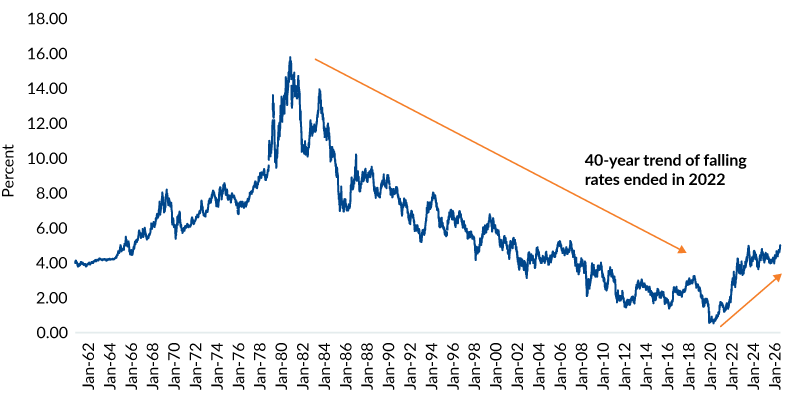
One of the most impactful market trends in recent years has been the continued normalization of the yield curve. For much of the period following the Global Financial Crisis, investors became accustomed to unusually low interest rates. That environment changed in 2022 with the end of a 40-year bull market in bonds. Treasury yields have repriced substantially higher, including another move upward in 2026 (Chart 1).
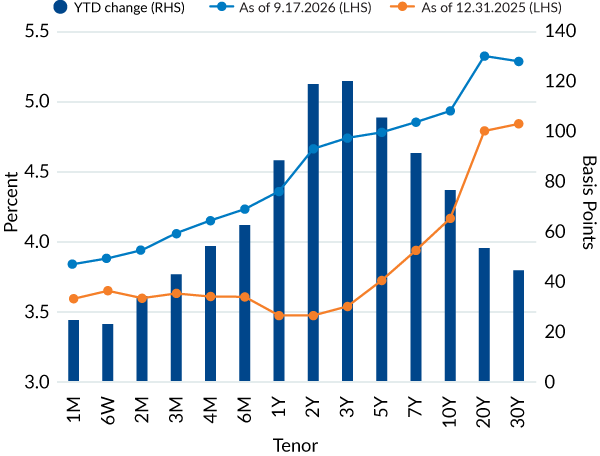
Bonds saw further repricing through the first three quarters of 2026, with rates rising across all tenors of the yield curve (Chart 2).
While the immediate impact of rising rates has been lower total returns from bonds, that impact has been felt differently depending on if your bond exposure is shorter-term or longer-term. Longer-term bonds, which carry more interest rate risk, have underperformed shorter-term bonds by 40.7% cumulatively since 2022, and 3.8% year-to-date (Table 1).
| Index | Cumulative return since 2022 | Return YTD |
|---|---|---|
| Bloomberg US Government Long TR USD | -29.8% | -2.8% |
| Bloomberg US Government Intermediate TR USD | 5.1% | 0.1% |
| Bloomberg US Government 1–3 Yr TR USD | 10.9% | 1.0% |
| Source: Morningstar, Mesirow. Data as of Sep-2026 | ||
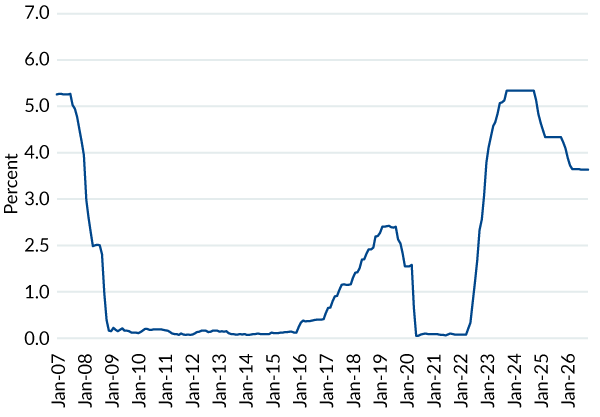
The Federal Reserve sets the federal funds rate, which directly influences the front end of the yield curve. This monetary policy tool allows the central bank to manage its dual mandate of price stability and maximum employment by easing or tightening access to money. The Federal Reserve aggressively tightened (increasing federal funds rate) in 2022 post-COVID as they aimed to control inflation (Chart 3).
The longer end of the yield curve is driven by market participants’ expectation for inflation and growth, future short-term rates, Treasury issuance, fiscal deficits, investor demand, and the additional “term premium” required to hold longer bonds. As mentioned earlier, market participants' concern about unchecked inflation stemming from a combination of the Iran conflict and US government debt load has bid up the middle-to-long end of the yield curve.
Yes! Higher rates have economic trade-offs that ripple through the economy while also creating potential opportunities for fixed income investors. The tradeoff is two-sided. All else equal, higher borrowing costs force the US government to pay more in interest, impact corporations’ willingness and ability to invest due to a higher cost of capital, make residential and commercial real estate mortgage rates move higher, and weigh heavily on households that rely on variable-rate borrowing. These are significant concerns, and if rates rise too high, too fast, we could see an economic pullback.
On the positive side of the ledger is the ability for investors to achieve higher income and potentially better diversification. Treasuries are paying a higher yield than earlier in the year, and certainly more than in the post-GFC period. Today’s higher starting yields provide investors with substantially more income and a larger potential cushion against inflation than was available during much of the post-GFC period. Further, with rates moving higher, there is the potential for Treasuries to buffer stocks in the event of an economic shock. This diversification was absent in 2022 when stocks and bonds sold off together (Table 2).
| Name | Dot-com Bear market(1) | Global financial crisis(2) | COVID shock(3) | 2022 Bear market(4) |
|---|---|---|---|---|
| S&P 500 | -32.82 | -45.80 | -19.57 | -17.70 |
| Bloomberg US Government Long | 36.60 | 22.68 | 12.97 | 32.71 |
| Source: Morningstar, Mesirow. Cumulative Returns. Data as of Sep-2026 | 1. March 2000 to October 2002 | 2. October 2007 to March 2009 | 3. February 2020 to March 2020 | 4. January 2022 to October 2022 | ||||
Rising yields have created plenty of concern for risky assets inside portfolios, but they have also improved the prospective return and diversification value of bonds. Investors should selectively consider opportunities to rebalance and/or reallocate within the fixed income portion of their portfolio.
Years of low rates and robust returns on riskier assets have led many investors to ignore the fixed income portion of their portfolio. However, as Treasury yields have reached their highest levels in nearly two decades, bonds may be a more compelling portfolio diversifier than they have been in years. As times change, it is important that investors position their portfolios for the future, not the past.
Whether you’re just starting your career, nearing retirement, or thinking about your legacy, your asset allocation choices will shape your financial future. Please consult with an advisor to determine what asset allocation decisions may be best for your financial situation.
Mesirow Wealth Management is a division of Mesirow Financial Investment Management, Inc., an SEC-registered investment advisor. Securities offered through Mesirow Financial, Inc., member FINRA, SIPC. Advisory Fees are described in Mesirow Financial Investment Management Inc.’s Part 2A of the Form ADV.