
Security tokenization is preparing to upend securities settlement tradition. Digitizing securities and placing them on a distributed ledger, or blockchain, means settlement can be instantaneous instead of one or two days after a trade. But there is a looming obstacle to settlement in seconds: foreign exchange. FX was not designed for instantaneous settlement.
FX enters a cross-border securities transaction near the end of the process. An investment manager buys a foreign security. The manager then orders an FX trade, often through a workflow separate from the securities process, to obtain the currency needed for settlement.
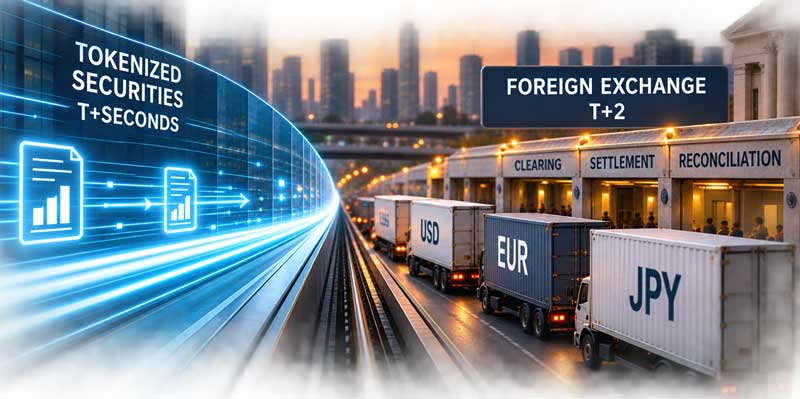
The problem is timing. Traditional FX settlement often occurs two business days after a trade, or T + 2.
Securities settlement cycles are outpacing FX. North America and India have moved to T + 1, while the UK and European Union are officially committed to T + 1 in October 2027. Some markets have moved parts of their securities infrastructure even closer to same-day settlement.
T + seconds may eventually follow. But having the correct amount of currency available for a securities transaction settling in seconds would require significant changes to the FX process.
Although most securities exist electronically, tokenization takes digitization further. Tokenization digitally represents an asset and records it on a distributed ledger. The token acts as a digital proxy for an equity, bond, commercial bank funds or another asset.
Ownership, transfer instructions and “if this, then that” logic can be encoded in smart contracts. Transactions involving those assets can then potentially be executed and settled on the same or interconnected ledgers with far less reconciliation between separate systems.
Atomic settlement can involve instant settlement, but speed is not its defining characteristic. Its distinguishing feature is conditionality: separate parts of a transaction are linked so that either all of them occur or none do.
For a foreign exchange transaction, atomic settlement could involve payment vs. payment: one currency is delivered only if the other currency is transferred.
Today, participants in securities and currency transactions maintain separate ledgers containing trade details and related transaction information. Reconciling those records adds steps to the settlement process and can tie up funds while settlement is pending.
Putting more elements of a transaction—security execution and confirmation, FX trading and settlement—on shared or interoperable infrastructure could reduce that reconciliation burden and allow previously sequential processes to occur together.
| Characteristic | Conventional FX Settlement | Atomic FX Settlement |
|---|---|---|
| Settlement cycle | Typically T+1 to T+2 days | Can be near-instant or programmed for later settlement |
| Settlement risk | Reduced through payment-vs-payment systems such as CLS; varies outside them | Reduced through all-or-nothing settlement of linked transaction legs |
| Processing | Often relies on sequential processes and batching | Settlement timing can be programmed; can be real time |
| Liquidity efficiency | Netting can substantially reduce funding requirements | Immediate gross settlement may require more liquidity; delayed or batched settlement can preserve some netting benefits |
| Primary technology | Existing payment and settlement infrastructure; SWIFT messaging | Distributed ledgers, tokenized money and smart contracts |
| Operating hours | Constrained by payment system operating hours, currencies and time zones | Potential for 24/7/365 |
| CLS - Continuous Linked Settlement uses payment versus payment to mitigate FX settlement risk. | ||
Delays in FX settlement reflect an infrastructure built over decades. Different messaging protocols, time-zone and business-hour mismatches, manual intervention and sequential clearing processes can all affect how quickly a transaction moves from execution to final settlement.
That creates a mismatch. A tokenized security capable of settling in seconds may still depend on an FX transaction operating on a much slower timetable.
One possible solution is programmable infrastructure that brings the necessary pieces closer together. A platform connecting tokenized securities, commercial bank money and potentially wholesale central bank digital currencies could allow the securities transaction, FX trade, compliance checks and other conditional logic to occur as part of a synchronized process rather than a sequence of largely separate steps.
Testing elements of this model are underway. The Bank for International Settlements (BIS), an international organization supporting central banks, and the Institute of International Finance developed Project Agorá, to explore how tokenization might improve cross-border payments involving commercial bank deposits and central bank money.
Earlier, BIS Project Mariana explored cross-border trading and settlement using hypothetical central bank digital currencies. Together, these projects help demonstrate some of the mechanics needed for programmable, coordinated cross-border settlement.
The benefits — and drawbacks — for FX are easy to see.
First, the difference between instant and atomic settlement is important. Atomic settlement can be instantaneous, but its primary advantage is linking the legs of a transaction. In some circumstances, immediacy is valuable because it reduces the period during which participants are exposed to settlement risk—the possibility that one party delivers what it is owed while the other does not.
But faster is not automatically better.
One reason is liquidity. Gross settlement processes transactions individually, requiring participants to have the necessary assets or cash available when each transaction settles. Netting, by contrast, allows offsetting obligations to cancel one another before settlement, potentially reducing the amount of liquidity participants must have available.
Moving every transaction toward immediate gross settlement could therefore increase liquidity requirements even as it reduces settlement risk.
Immediate settlement also raises coordination issues. A security may reside on one ledger while the cash or currency needed to pay for it resides on another. If those systems cannot communicate reliably, shortening the settlement window leaves less time to resolve a funding or operational problem.
This is where the programmable feature of atomic settlement may ultimately prove more important than sheer speed.
Participants could potentially choose when a transaction settles, allowing time to batch transactions, net obligations and manage liquidity while still preserving the all-or-nothing protection of atomic settlement. The future of settlement, in other words, may not be that every transaction settles immediately. It may be that every transaction can settle when it makes the most economic sense.
Stablecoins, digital tokens designed to maintain their value relative to another asset such as the US dollar or euro, could provide an intermediate step to FX atomic settlement.
A securities transaction requiring an FX conversion might use an agreed FX rate and settle using the appropriate amount of currency-denominated stablecoins or other forms of tokenized money.
That would not eliminate FX. Instead, it would change the form in which the currencies used for settlement are represented and transferred.
Atomic settlement will likely unfold in stages.
Some steps to faster and programmable settlement have already occurred. Others are underway, while still others remain distant:
At some point, atomic settlement could become commercially meaningful rather than experimental. FX might become part of a growing number of atomic transactions while legacy settlement processes continue alongside them.
Market participants choose the FX process that best balances speed, liquidity, risk and cost.
Atomic settlement is quietly gathering momentum. Securities are becoming tokenized. Commercial bank money is beginning to appear in tokenized form. Stablecoins provide another form of digital money, while central banks and financial institutions continue experimenting with new settlement infrastructure.
What remains uncertain is when those pieces will come together on a scale sufficient to make atomic cross-border settlement commercially practical. Tokenization might follow the path of the electronic reader. The technology existed years before the Kindle transformed the market. What changed was not the underlying idea but the infrastructure around it: suddenly the technology became convenient enough to use at scale. Atomic settlement may be approaching a similar point. Securities, commercial bank money and potentially fiat currencies are becoming tokenized, but the infrastructure connecting them—and particularly FX—still has to catch up. When that happens, the result may not be instant settlement for every transaction. Market participants may instead gain the ability to choose the settlement speed that best balances risk, liquidity and cost.
Perhaps the future of settlement isn't T + 0 or T + seconds. It's T + when it makes sense.
Atomic settlement is quietly gathering momentum
Connect with us to learn more about Mesirow Currency solutions

Customized solutions to manage unrewarded currency risk in international portfolios.

Strategies that aim to profit from short and medium-term moves in the currency market.

Trading solution for asset managers and owners with focus on reducing transaction costs, improving transparency and enhancing efficiency.
The information contained herein should not be construed as a recommendation to purchase or sell any particular security or investment vehicle offered by Mesirow . The information included has been obtained from sources believed to be reliable, but is not necessarily complete and its accuracy cannot be guaranteed. Any opinions expressed are subject to change without notice. Mesirow Financial Investment Management, Inc. and its affiliated companies and/or individuals may, from time to time, own, have long or short positions in, or options on, or act as a market maker in, any securities discussed herein and may also perform financial advisory or investment banking services for those companies. It should not be assumed that any recommendations incorporated herein will be profitable or will equal past performance. Any stated performance results include the reinvestment of dividends and other earnings. Investment management services offered by Mesirow Financial Investment Management, Inc., an SEC-registered investment advisor.