Election season has a way of following investors everywhere. It can dominate the evening news, stir debate at the family dinner table and create concern about what a change in leadership might mean for the country. When market volatility rises at the same time, it can be tempting to interpret every movement through a political lens.
Those concerns are understandable, since elections can influence taxes, regulation, government spending and the outlook for individual industries. However, markets are not a simple referendum on one political party or one election result.
Political views may guide how we vote, but they should not dictate how we invest. A portfolio should be built around an investor’s financial goals, time horizon, spending needs and ability to accept risk. It should not depend on correctly predicting what will happen on election night.
Elections often cause tension across the country, and the S&P 500 is no exception. Investors are evaluating possible changes in congressional control, the direction of fiscal policy and what those changes could mean for businesses and households.
History suggests that this uncertainty contributes to higher market volatility. The bar chart below shows that since 1970, volatility in the S&P 500 has historically increased during the months leading up to a midterm election and has been much higher than those months’ long-term averages. During midterm election years, the six months leading up to a midterm election have also demonstrated elevated volatility compared to the rest of the year, with October historically being the most volatile month.
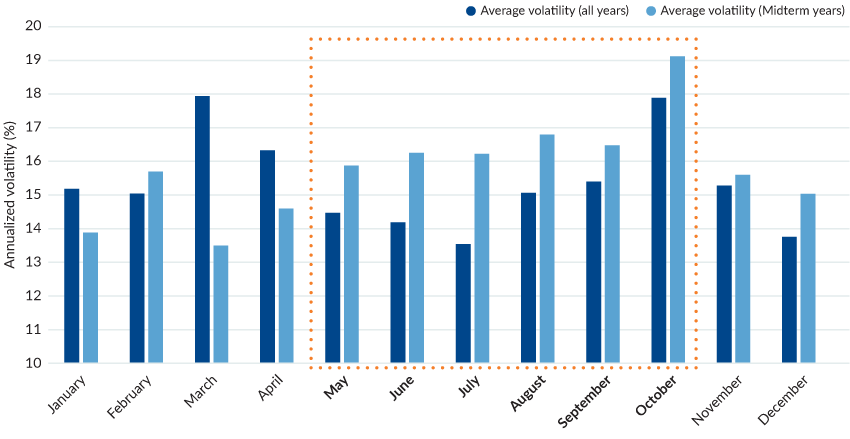
This comparison should not be interpreted as evidence that elections cause every market fluctuation. Inflation, interest rates, geopolitical developments and changes in business conditions can all contribute to volatility. An election may dominate the headlines without being the primary force moving markets.
The distinction matters when considering a portfolio change. Feeling uneasy about the direction of the country is not the same as experiencing a change in retirement plans, spending needs or investment time horizon. Those financial considerations should remain the foundation of investment decisions, even when the political environment feels uncertain.
Despite the uncertainty that can precede a midterm election, market performance following election day has historically been strong.
As seen by the table below, across the 14 midterm elections from 1970 through 2022, the S&P 500 delivered positive total returns in every subsequent twelve-month period, with an average gain of 16.9%, well above the index’s long term average annual return.
These results should provide perspective, however, and not a trading signal. Investors should not interpret a favorable historical pattern as a reason to expect an automatic rally after every election. Rather, the historical record provides perspective. The uncertainty investors feel before an election typically creates some negative sentiment that becomes reflected in stock prices. This does not mean stocks will necessarily rise after an election, but an upcoming election can, at times, be the reason stocks sell off in the preceding months.
It is also too simplistic to assume that a particular balance of power in Washington creates an ideal investment environment. A unified Federal government does not guarantee superior economic policies will be passed, and divided government does not automatically produce better fiscal conditions. The implications depend on the policies enacted and the economic environment in which they take effect.
A resilient portfolio does not require a perfect election forecast. It requires an understanding that markets can respond in unexpected ways, even when the political result appears predictable.
Even a correct election prediction leaves important questions unanswered. Which policies will actually be implemented? How much of their potential impact is already reflected in investment prices? What other economic developments might occur at the same time?
Rather than make a financial plan dependent on those answers, investors should focus on balancing the risks and opportunities they can assess.
Regardless of the election night result, current valuations, inflation, Federal Reserve policy, corporate earnings, consumer spending, business investment and the pace of economic growth will continue to shape market performance. Some of these forces may be influenced by Washington, but none is determined by an election outcome alone.
The S&P 500 has grown substantially over the past 50+ years regardless of what party is in control, as seen in the chart below.
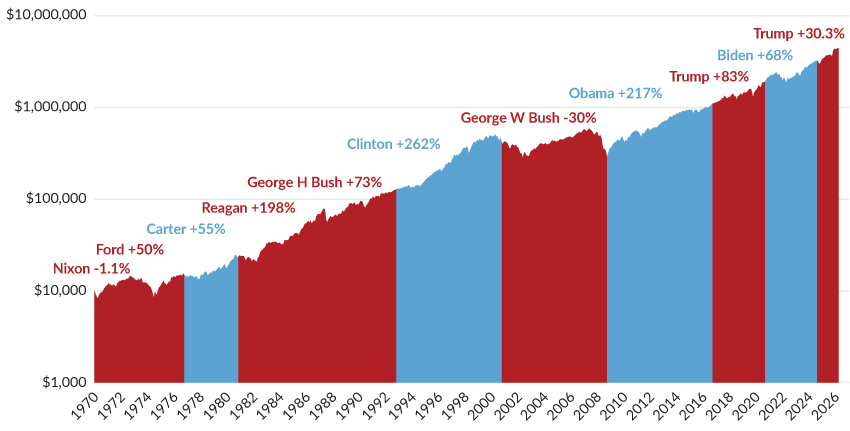
An election result should not change when an investor expects to retire, how much income a portfolio needs to provide or the importance of preserving assets for future generations. Those objectives should remain the starting point for portfolio construction.
A change may be appropriate if an investor’s financial circumstances have changed. It is less likely to be appropriate when it is based primarily on enthusiasm or concern about a political outcome.
Resilience does not mean avoiding risk altogether. While volatility leading up to an election can cause you to question your investment strategy, it is imperative to stay the course and not be distracted by short term headwinds. The goal is not to eliminate risk and uncertainty; it is to have financial plan that balances both risks and opportunities in the market without being distracted by headline noise.
A portfolio that depends on one election result is not diversified. Exposure to different asset classes, industries, company sizes, countries and investment styles can help reduce dependence on one policy agenda or economic scenario.
Diversification cannot prevent every loss or ensure a profit. Its purpose is to reduce reliance on any one outcome, including outcomes that initially appear highly likely.
Election years can be noisy, emotional and unpredictable. A financial plan should provide a steadier point of reference. Keeping investment decisions connected to financial goals, evaluating economic fundamentals and maintaining appropriate diversification can help investors look beyond election night toward the objectives their portfolios are intended to support.
Consult with a Mesirow advisor to ensure that your investment portfolio is aligned with your financial objectives and goals.
Mesirow Wealth Management is a division of Mesirow Financial Investment Management, Inc., an SEC-registered investment advisor. Securities offered through Mesirow Financial, Inc., member FINRA, SIPC. Advisory Fees are described in Mesirow Financial Investment Management Inc.’s Part 2A of the Form ADV.