
"How did I do?" Every institutional foreign exchange trader asks this question at the close of a session. The answer is critical. Two asset managers can make identical investment decisions yet generate vastly different net returns because one executes its FX trades more effectively. For large public and private pension funds, where a few basis points can translate into millions of dollars, execution quality is no longer just a compliance checkbox—it is a distinct competitive advantage.
The FX landscape has fundamentally transformed over the past two decades. What was once a highly centralized, over-the-counter market dominated by a handful of global tier-1 banks has become a decentralized market supported by a diverse mix of banks, non-banks and electronic liquidity providers. Today, non-bank LPs compete directly with market makers, liquidity is dispersed across dozens of electronic venues, and algorithms dictate execution.
To keep pace, transaction cost analysis has undergone its own structural evolution—shifting from a passive retrospective audit into the central nervous system of modern FX execution strategy.
To understand where FX trading is going, we must look at how the data architecture was built. The table below condenses the first two generations of FX TCA. It illustrates how regulatory mandates and electronic trading shifted the industry from opaque, quote-driven pricing to data-driven post-trade evaluation.
As electronic communication networks (ECNs) matured, the introduction of the anonymous Central Limit Order Book (CLOB) changed the rules of engagement. Instead of asking multiple banks for a quote, traders could interact directly with an anonymous screen displaying the best bids and offers, cleared via a prime broker.
This structural shift broke traditional, benchmark-style TCA. In an anonymous CLOB environment, evaluating a trade against a static mid-price became meaningless. Instead, TCA had to adapt to measure real-time order-book dynamics:
Today, currency markets face unprecedented complexity. Geopolitical shocks, sudden collapses of displayed liquidity, and the rise of internal bank matching engines mean the challenge is no longer finding liquidity—it is identifying reliable liquidity.
FX liquidity is distributed across global banks, non-bank market makers, independent ECNs, and private internalization pools used by LPs to warehouse and match client flow. A single institutional order is routinely sliced into thousands of micro-orders, interacting with dozens of distinct liquidity sources before completion.
Consequently, modern TCA has evolved from a lagging retrospective report into an active, data-driven behavioral tool.
Evaluating algorithmic trades against a single static benchmark is highly misleading. If an algorithm executes a massive order over four hours during a period of extreme market volatility, comparing the final price to a single morning benchmark is meaningless. Modern TCA utilizes peer-group analytics, shifting the question from "Did the algorithm beat a screen price?" to "How did this specific algorithm perform compared to institutional peers executing identical orders under identical market conditions?"
In a smart order routing environment, TCA has migrated from a passive PDF report sent to the compliance team to an active data feed hooked directly into the trading desk. Modern TCA provides the quantitative intelligence that instructs the SOR where to route, when to pause, and which market makers to avoid based on their historical behavior.
Ultimately, the benefit of this data framework is realizing better trading outcomes in the live market. In a modern execution environment, hitting "buy" or "sell" is no longer a static event. Live market execution represents the culmination of the loop—where real-time price discovery occurs across dozens of hidden and public venues simultaneously. Backed by SOR intelligence and peer analytics, the execution phase allows algorithms to make split-second routing adjustments. This ensures that large institutional blocks are filled at the best available prices across the fragmented FX landscape while minimizing immediate market impact.
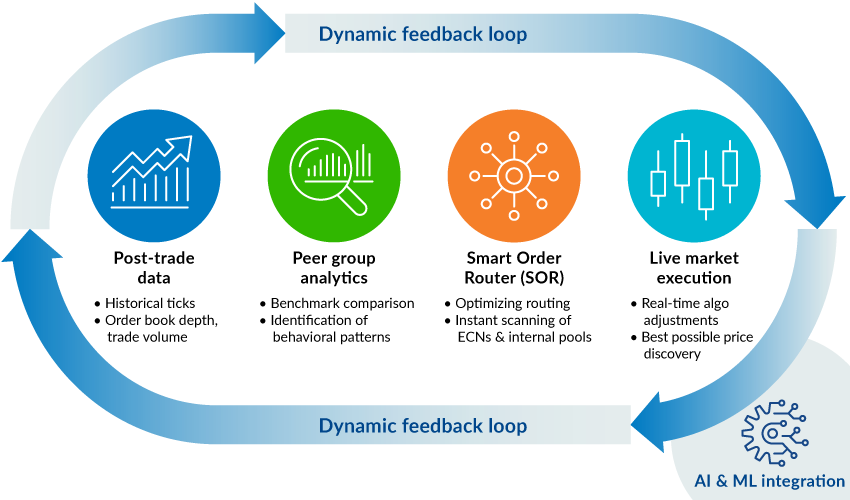
While modern live execution excels at reacting to milliseconds-level changes in the market, the integration of artificial intelligence shifts FX TCA from a reactive tool into a proactive, autonomous trading partner.
Traditional TCA looks at historical ticks. In contrast, predictive AI models continuously ingest live market variables—including macro news feeds, order book depth, and historical pattern recognition—to anticipate what will happen next.
Instead of an algorithm simply reacting to a filled or rejected order, predictive AI forecasts how liquidity will shift over the next several minutes. If a steep drop in liquidity is anticipated, AI proactively alters the entire trading schedule before the market shifts. Ultimately, this transforms trading into a truly closed loop, diagnosing inefficiencies and recalibrating the broader strategy ahead of the market.
While TCA excels at the quantitative aspects of FX trading—analyzing spreads, fill rates, and execution speeds—the next frontier involves quantifying the qualitative: the value of the relationship between the liquidity provider and the institutional client.
For an investment manager, the most valuable liquidity providers are not always those offering the narrowest spreads during calm markets. The true value of a trusted partner is revealed during market crises. Exceptional LPs are defined by behaviors that traditional analytics often miss:
Advanced TCA frameworks are designed to score these behavioral traits, assigning a quantifiable value to counterparty reliability so that investment managers can reward consistent partners with more volume.
Foreign exchange execution has quietly become one of institutional investing’s premier competitive battlegrounds. As currency liquidity continues to fragment and markets react instantaneously to global events, TCA has outgrown its origin as a compliance audit.
The pension funds and investment managers that secure the greatest long-term advantage will not necessarily be those with the most colorful compliance dashboards—they will be the institutions that leverage TCA data to identify trustworthy counterparties, refine algorithmic strategies, and improve execution before the next trade is placed.
Foreign exchange execution has quietly become one of institutional investing’s premier competitive battlegrounds.
Connect with us to learn more about Mesirow Currency solutions

Customized solutions to manage unrewarded currency risk in international portfolios.

Strategies that aim to profit from short and medium-term moves in the currency market.

Trading solution for asset managers and owners with focus on reducing transaction costs, improving transparency and enhancing efficiency.
The information contained herein should not be construed as a recommendation to purchase or sell any particular security or investment vehicle offered by Mesirow . The information included has been obtained from sources believed to be reliable, but is not necessarily complete and its accuracy cannot be guaranteed. Any opinions expressed are subject to change without notice. Mesirow Financial Investment Management, Inc. and its affiliated companies and/or individuals may, from time to time, own, have long or short positions in, or options on, or act as a market maker in, any securities discussed herein and may also perform financial advisory or investment banking services for those companies. It should not be assumed that any recommendations incorporated herein will be profitable or will equal past performance. Any stated performance results include the reinvestment of dividends and other earnings. Investment management services offered by Mesirow Financial Investment Management, Inc., an SEC-registered investment advisor.