
You might guess that an FX swap involves exchanging one currency for another. But there's a twist: the exchange is temporary, and the participants agree at the outset to reverse it on a specified date.
Why would anyone do that?
Often the answer is funding. An institution may need euros for a month but have dollars on hand. An FX swap lets it obtain the euros now and lock in the terms for returning them later. Swaps also help investors maintain currency hedges and manage short-term cash flows. They can support trading strategies, too, but their everyday importance lies in moving liquidity between currencies.
A spot trade exchanges currencies at a rate agreed today, with settlement typically two business days later. A forward trade sets the exchange rate today for a currency exchange on a specified future date.
An FX swap links a spot trade and a forward trade in a transaction with two offsetting legs. The spot trade—the near leg—delivers one currency against another on the initial settlement date. The forward trade—the far leg—reverses that exchange at a later date, at a rate agreed when the swap is arranged. Although the two trades are linked, their exchange rates are generally different.
Consider a US investor who needs €1 million for 30 days. For simplicity, assume the near-leg exchange takes place today:
Both exchange rates are set when the swap is arranged. The investor has effectively obtained temporary euro funding against dollars, without leaving the future exchange rate to chance. The $4,000 difference between the dollar amounts is part of the swap’s implied funding economics—not a guaranteed investment profit.
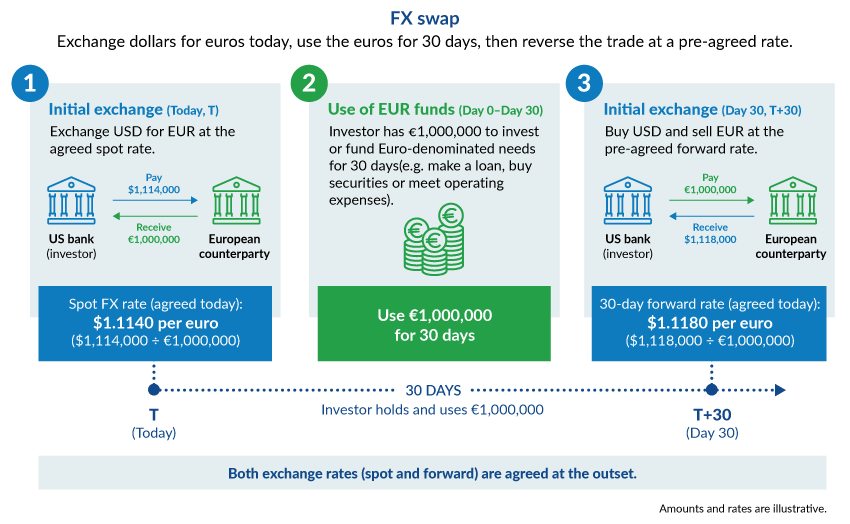
The difference between the spot and forward exchange rates is expressed as forward points, also called swap points. In the example, the difference is $0.0040 per euro, or 40 points when EUR/USD is quoted to four decimal places.
Interest-rate differences are the principal driver of forward points, but market funding conditions also matter. One measure of funding pressure is the cross-currency basis, which reflects the difference between the cost of obtaining a currency through an FX swap and the cost implied by interest-rate differences. This deviation can widen during periods of market stress, when demand for dollar funding increases or banks become less willing to supply it.
The names sound similar, but the instruments serve different purposes. An FX swap usually involves two exchanges of principal over a relatively short period, without periodic interest payments. A cross-currency swap commonly runs for years and can involve exchanges of principal and periodic interest payments. The latter is often used to transform longer-term funding or liabilities from one currency into another.
| Feature | FX swap | Cross-currency swaps |
|---|---|---|
| Duration | Usually short-term (days, weeks, months) | Usually long-term (years) |
| Interest payments | No periodic interest payments are exchanged | Parties exchange periodic interest payments (fixed or floating) |
| Primary purpose | Manage short-term liquidity or rolling hedges | Raise funding in foreign markets or change liability structure |
Temporary funding is the most straightforward use. A bank, corporation or investor with dollars but a near-term euro obligation can exchange the US currency for euros and arrange the reversal in advance. The transaction avoids having to buy euros now and face an uncertain exchange rate when the euros are no longer needed.
FX swaps also help investors roll currency hedges. Suppose a US pension fund owns European equities and has sold euros forward to reduce its currency exposure. As that forward approaches maturity, the fund may use an FX swap to settle the expiring obligation and establish a new forward sale for a later date. The hedge continues, with its maturity moving forward.
These transactions link the FX market to money markets. The prices of short-dated swaps reflect relative funding costs, central-bank policy and the supply of and demand for particular currencies. FX swaps can also reveal stress in funding markets. Unusually expensive dollar funding through swaps may indicate heightened demand for dollars or balance-sheet constraints that limit banks' and FX dealers' ability to provide funding.
For international investors, managing exchange-rate uncertainty is only part of the equation. The cost of hedging or obtaining funding—and how that cost changes over time—also matters.
Hedge tenor also matters. A portfolio manager who typically rolls currency hedges monthly may find that three-month contracts offer more attractive economics. But changing the roll schedule can introduce tracking error—a statistical difference between the portfolio’s return and that of its benchmark—if the benchmark assumes monthly rolls. The performance difference is not necessarily a loss; it may reflect a deliberate trade-off between hedging costs and benchmark tracking.
An FX swap may look like a spot trade and a forward trade stitched together. Economically, however, it is often a short-term funding arrangement executed through the currency market. That is why swaps matter far beyond the trading desk: they help banks, companies and investors obtain the currencies they need, when they need them, while making the cost of reversing the exchange known in advance.
FX swaps rarely attract attention outside financial markets, yet they play an essential role in managing currency risk and moving short-term funding across currencies and borders. They are part of the invisible plumbing that keeps global finance running.
FX swaps allow investors to obtain temporary funding in another currency, manage currency risk and adjust hedges without taking a long-term view on exchange rates.
Two linked trades provide flexibility in managing funding and currency exposures.
Connect with us to learn more about Mesirow Currency solutions

Customized solutions to manage unrewarded currency risk in international portfolios.

Strategies that aim to profit from short and medium-term moves in the currency market.

Trading solution for asset managers and owners with focus on reducing transaction costs, improving transparency and enhancing efficiency.
The information contained herein should not be construed as a recommendation to purchase or sell any particular security or investment vehicle offered by Mesirow . The information included has been obtained from sources believed to be reliable, but is not necessarily complete and its accuracy cannot be guaranteed. Any opinions expressed are subject to change without notice. Mesirow Financial Investment Management, Inc. and its affiliated companies and/or individuals may, from time to time, own, have long or short positions in, or options on, or act as a market maker in, any securities discussed herein and may also perform financial advisory or investment banking services for those companies. It should not be assumed that any recommendations incorporated herein will be profitable or will equal past performance. Any stated performance results include the reinvestment of dividends and other earnings. Investment management services offered by Mesirow Financial Investment Management, Inc., an SEC-registered investment advisor.