
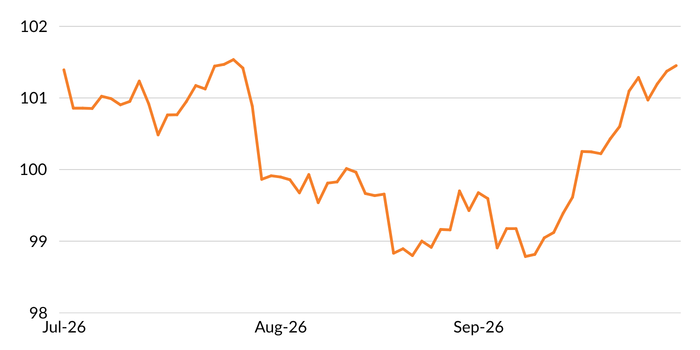
US dollar was a middling G10 performer in Q3, with weakness through much of the quarter giving way to a strong September finish. Weak labor data and below-expected inflation weighed on the dollar earlier in the quarter, as the Fed was less hawkish than expected in July. Intermittent safe-haven demand provided support amid mixed messaging over the war, while concerns over US fiscal sustainability resurfaced as yields rose. Coordinated Yen intervention reinforced broad dollar weakness mid-quarter. US dollar reversed course in September as a hawkish Fed stance, including a 25bps rate hike, stronger-than-expected payrolls, and better-than-expected PMIs reinforced the case for tighter policy. Elevated energy prices added to expectations for further Fed tightening, supporting USD’s strong finish to the quarter
EUR | Euro finished in the lower half of the G10 in Q3 as stagflationary concerns and political risks weighed on sentiment. Softer inflation early in the quarter supported the ECB’s decision to hold rates steady. More hawkish ECB rhetoric emerged later in the quarter, highlighting the need for rate hikes as PMIs exceeded consensus. The global energy shock heightened stagflationary concerns, with EZ natural gas prices reaching their highest level since 2023 amid elevated inflation. French and German political risks added to pressure on Euro, with the OAT-Bund spread widening.
GBP | Sterling was a relatively strong performer in Q3, with a solid September finish due to resilient revisions along with reassurances of fiscal discipline from PM Burnham. UK yields and carry supported Sterling despite a sharp increase in energy prices. The BoE kept rates on hold at 3.75% amid persistent inflation risks. Governor Bailey noted that while financial conditions should continue to exert downward pressure on inflation, an extended Middle East conflict could require tighter monetary policy. Inflation remained elevated, as the most recent headline and core CPI were in line with consensus at 3.1% and 2.6% YoY, respectively. Sterling strengthened further towards quarter-end amid resilient growth data and a constructive political backdrop.
JPY | Yen outperformed the rest of the G10 in Q3, driven by intervention coordination and threats along with hawkish expectations for the BoJ. As the BoJ hiked in September by 25bps as expected, Board Member Takata commented that larger rate increases exceeding 0.25% and consecutive rate hikes remained possible. With Governor Ueda emphasizing the need to stabilize prices near 2% and discussions between the Japanese and US officials occurring near quarter-end, Yen was well supported during Q3.
CHF | Swiss franc underperformed the rest of the G10 in Q3, as high oil prices continued its pressure. The SNB announced that their expectation to keep rates at 0 until the end of 2027. Although inflation surprised higher late in the quarter after being contained, printing at 0.8% YoY vs. 0.5% consensus, the SNB held rates steady at 0% without confirming hawkish market pricing as the lack of carry continued to be an issue. Unemployment behaved and retail sales were robust.
CAD | Canadian dollar was a middling performer in the G10 in Q3, weighed down by the ongoing trade frictions with the US. Although firmer oil prices were somewhat supportive, Fed vs. BoC policy divergence kept CAD contained. The BoC left rates unchanged as expected, noting that the recent escalation in trade tensions posed upside risks to inflation and downside risks to growth. The most recent employment data disappointed while inflation printed in-line at 3.0% YoY.
AUD | Australian dollar landed in top third of the G10 in Q3, leveraging its carry appeal. The RBA hiked rates by 25bps to 4.6%, with the Board noting that inflation remains elevated, driven by the conflict in the Middle East, higher energy prices, and pressure on domestic capacity. Further rate hikes remained on the table to bring inflation down to target. The most recent prints for unemployment rose to 4.6% while headline inflation printed 4.0% YoY vs. 4.1% consensus.
EM | EM currencies gained during the quarter, reflected by a 3.92% increase in the MSCI EM Currency index on shifting global monetary policies and regional dynamics. July and August were supported by a weaker US dollar and non-hawkish Fed, while keeping the gains during the dollar-reversal in September. Attractive yield differentials supported carry as surging commodity pricing benefited exporters as the Middle East conflict continued. The Trump-Xi summit ended on a constructive note, with both sides agreeing on "building a constructive relationship of strategic stability."
| Change 3M % | FX rate | ||
|---|---|---|---|
| EUR |  | -0.65% | 1.13585 |
| GBP |  | 0.09% | 1.32845 |
| JPY | | 3.43% | 157.135 |
| AUD | | 0.42% | 0.6957 |
| CAD | | -0.07% | 1.41975 |
| CHF | | -3.39% | 0.83495 |
Mesirow Currency’s Extended Markets Currency Alpha, Asian Markets Currency Alpha, Emerging Markets Currency Alpha and Systematic Macro strategies all ended up with positive returns for the quarter. The non-correlated, mean reverting, and machine learning models in our Technical strategy and the Relative Value model in our Fundamental set of models performed the best in Q3.
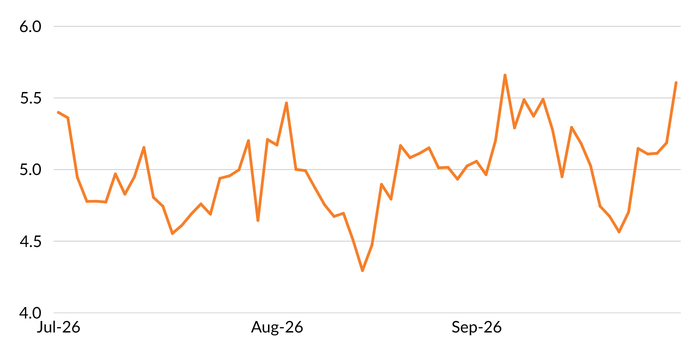
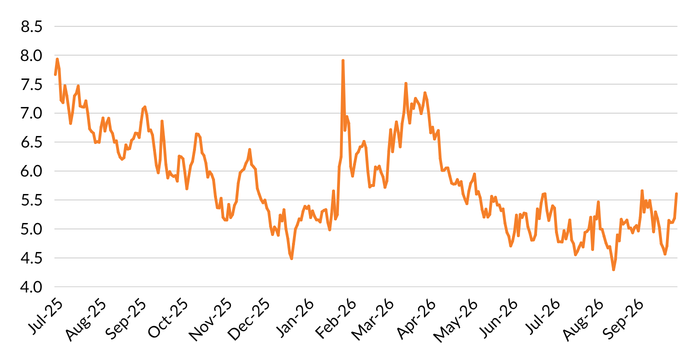
Our proprietary Global Volatility Indicator (GVI) fell throughout the quarter (Figure 2) as it continues to fall YTD (Figure 3).
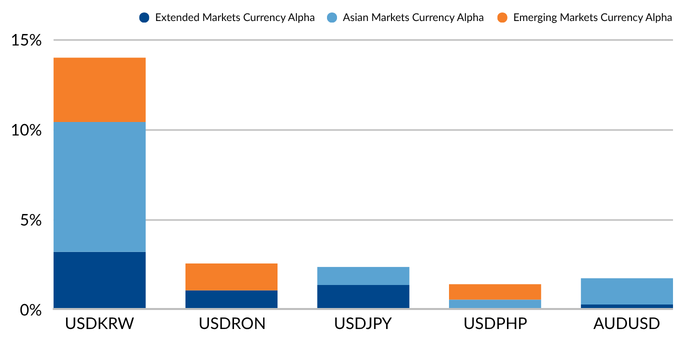
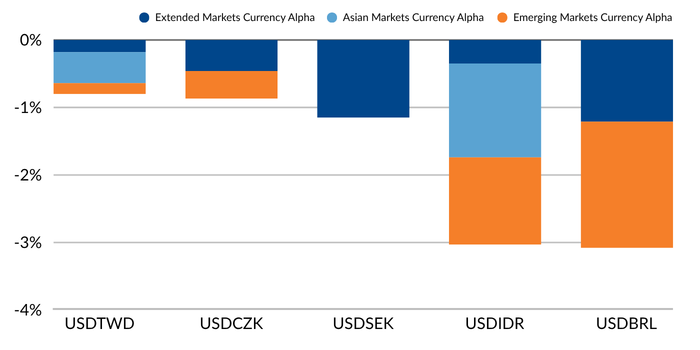
Our short USD position against the Korean won performed particularly well over the quarter and added value to all three strategies. Our long Australian dollar made gains during July and August as the USD depreciated, and our long US dollar position against the Romanian leu added value during September as the USD appreciated (Figure 4). Our long US dollar against the Indonesian rupiah and our positions against the Brazilian real lost money 3Q2026 (Figure 5).
FIGURE 2: MCM'S GLOBAL VOLATILITY INDICATOR1 | 3Q2026
Mesirow Currency’s Intelligent Currency Factor strategy added 1.40% (gross) over the quarter as short US dollar positioning in July and August were rewarded, with long USD positions remaining productive in September. Carry and Value were both strong factors this quarter, as Momentum lagged behind, netting to outperformance in Q3. Swiss franc positioning contributed most to added value, with strong returns through both Carry and Value. Other positions were mixed, with positive Australian dollar, Norwegian krone, and Swedish krona netted against negative Euro, Sterling, and Yen, ultimately returning +140bps at the portfolio level this quarter.
Connect with us to learn more about Mesirow Currency solutions

Customized solutions to manage unrewarded currency risk in international portfolios.

Strategies that aim to profit from short and medium-term moves in the currency market.

Trading solution for asset managers and owners with focus on reducing transaction costs, improving transparency and enhancing efficiency.
The information contained herein should not be construed as a recommendation to purchase or sell any particular security or investment vehicle offered by Mesirow . The information included has been obtained from sources believed to be reliable, but is not necessarily complete and its accuracy cannot be guaranteed. Any opinions expressed are subject to change without notice. Mesirow Financial Investment Management, Inc. and its affiliated companies and/or individuals may, from time to time, own, have long or short positions in, or options on, or act as a market maker in, any securities discussed herein and may also perform financial advisory or investment banking services for those companies. It should not be assumed that any recommendations incorporated herein will be profitable or will equal past performance. Any stated performance results include the reinvestment of dividends and other earnings. Investment management services offered by Mesirow Financial Investment Management, Inc., an SEC-registered investment advisor.