
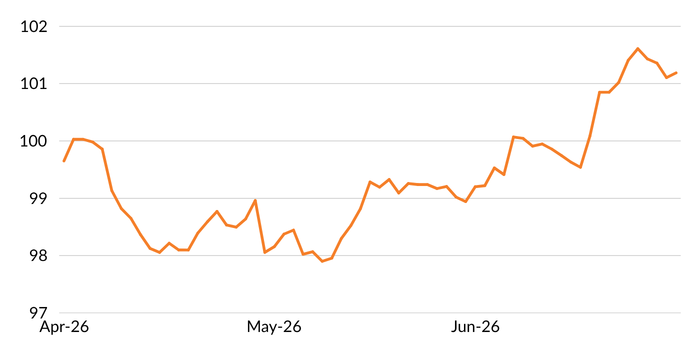
US dollar was a top-third G10 performer in Q2 as resilient US data, persistent inflation, hawkish Fed repricing, and intermittent geopolitical tensions offset periods of broad risk-on sentiment. Geopolitical developments continued to drive pricing, with Middle East tensions supporting safe-haven demand while periods of de-escalation triggered USD selloffs. Stronger-than-expected labor market data and rising inflation reinforced US exceptionalism, with non-farm payrolls consistently surprising to the upside and energy prices hitting inflation. The Fed became progressively more hawkish over the quarter, culminating in upward revisions to the dot plot and new Chair Warsh reinforcing the Fed's commitment to price stability. Yen intervention had only a temporary effect, washed out by resilient economic data and tightening policy expectations.
EUR | Euro was a middling G10 performer over Q2, as persistent stagflation concerns and slowing growth offset support from a hawkish ECB. Eurozone activity weakened through the quarter, with composite PMI readings moving into and remaining in contractionary territory as investors became increasingly focused on the region's deteriorating growth outlook. Inflation remained elevated, reinforcing concerns that higher energy prices were feeding into broader price pressures. The ECB maintained a hawkish stance throughout the quarter, culminating in a 25bps rate hike while continuing to emphasize upside inflation risks. Despite firmer inflation and hawkish policy, expectations for slower growth continued to weigh on the common currency.
GBP | Sterling was a high G10 performer over Q2, as resilient consumer data and improving global risk sentiment outweighed softer domestic fundamentals and political uncertainty. Domestic economic data were mixed, with stronger GDP, retail sales, and a sharp upside surprise in retail spending offset by softer labor market conditions, slowing wage growth, and contractionary services activity. The BoE kept rates unchanged throughout the quarter as policymakers continued balancing persistent inflation against downside growth risks. Improving global risk sentiment was supportive of Sterling. Amid domestic political developments, markets largely looked through Prime Minister Starmer's resignation and focused on the incoming government's economic agenda.
JPY | Yen was the weakest G10 performer over Q2, as persistent yield differentials, elevated energy prices, and broad US dollar strength outweighed a more hawkish BoJ and repeated intervention efforts. The BoJ shifted gradually toward tighter policy, hiking by 25bps to 1.0% and signaling upside inflation risks. Repeated intervention and persistent rhetoric temporarily stabilized JPY, but the effects were short-lived as USDJPY moved beyond historical intervention levels. While periods of lower oil prices were briefly supportive, energy price strength and wide yield differentials pressured Yen during the quarter.
CAD | Canadian dollar was the second weakest G10 performer over Q2, as softer domestic data, relative US dollar strength, and interest rate differentials outweighed intermittent support from higher oil prices. Oil remained an inconsistent driver with the traditional CAD-oil relationship weakening broader US dollar strength became more influential. Domestic data were mixed overall, with softer employment, inflation, and GDP through much of the quarter giving way to stronger labor market data and firmer inflation later in the period. The BoC kept rates unchanged at 2.25% throughout the quarter, with a focus on preventing higher energy prices from feeding into persistent inflation through short-term geopolitical volatility.
AUD | Australian dollar was the best-performing G10 currency over Q2, as supportive global risk sentiment and relatively hawkish RBA policy outweighed slowing domestic growth. Improving global risk sentiment early in the quarter provided strong support for the high-beta currency, though renewed geopolitical uncertainty and weaker equity markets later reduced upside. The RBA maintained a relatively hawkish policy stance, hiking by 25bps before holding rates steady to balance persistent inflation pressures against slowing economic growth, evident through rising unemployment and slowing activity.
CHF | Swiss franc was a middling G10 performer over Q2, as safe-haven demand and constructive domestic fundamentals were balanced by persistent SNB intervention rhetoric and shifting geopolitical sentiment. Safe-haven flows were supportive during episodes of geopolitical tension, though improving global risk sentiment and higher oil prices limited sustained gains. Inflation moved modestly higher during the quarter, while unemployment stayed low and broader domestic conditions remained relatively constructive. The SNB kept rates unchanged, signaling its willingness to limit excessive CHF appreciation.
EM | EM currencies gained during the quarter, reflected by a 1.25% increase in the MSCI EM Currency index, as supportive global risk sentiment and improving investor demand for higher-yielding assets offset intermittent geopolitical volatility. Although a stronger US dollar and hawkish Fed repricing provided headwinds later in the quarter, EM currencies were broadly supported by resilient domestic fundamentals and commodity prices.
| FX Rate | Change 3M % | Change 1Y% | ||
 |
EUR-USD | 1.1433 | -0.77% | -2.60% |
 |
GBP-USD | 1.32725 | 0.65% | -3.15% |
 |
USD-JPY | 162.525 | -2.11% | -11.12% |
 |
AUD-USD | 0.6928 | 1.15% | 5.71% |
 |
USD-CAD | 1.41875 | -1.64% | -3.82% |
 |
USD-CHF | 0.80665 | -0.38% | -1.32% |
| Source: WM/Reuters | ||||
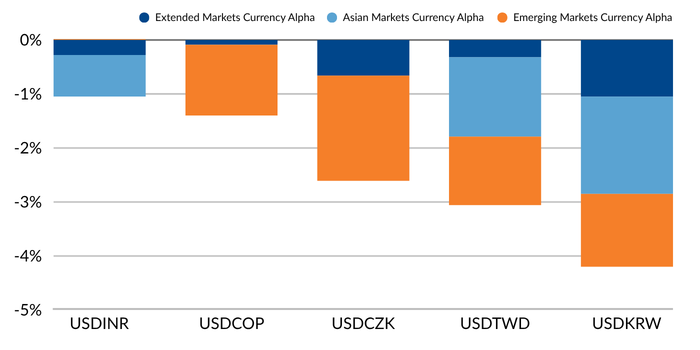
Mesirow Currency’s Extended Markets Currency Alpha, Asian Markets Currency Alpha, Emerging Markets Currency Alpha and Systematic Macro strategies all ended up with positive returns for the quarter. The non-correlated and mean reverting models in our Technical strategy and the Forward Rate Bias model in our Fundamental set of models performed the best in Q2.
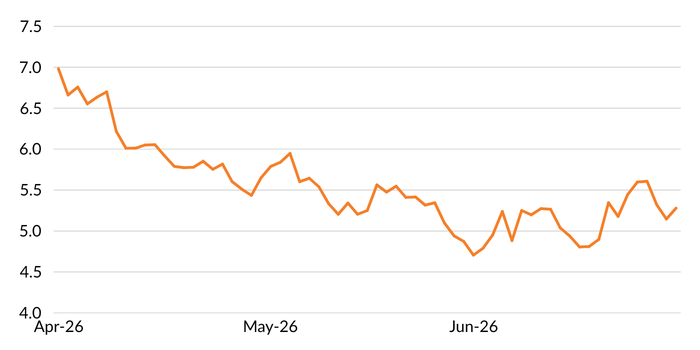
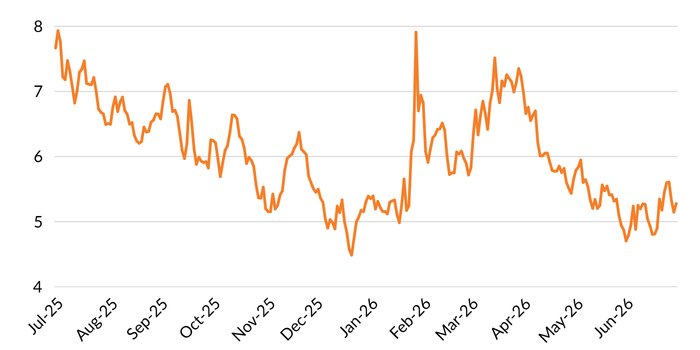
Our proprietary Global Volatility Indicator (GVI) fell throughout the quarter (Figure 2).
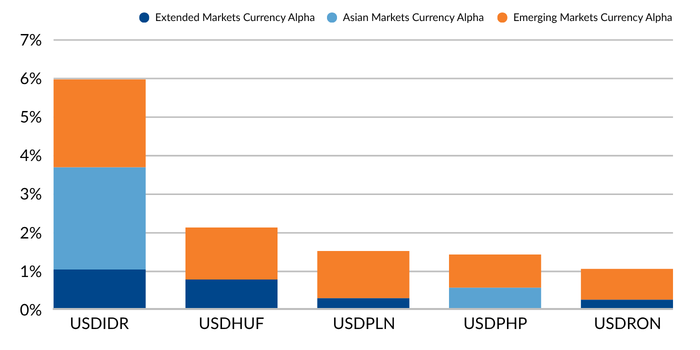
The alpha strategy’s best performer was a long US dollar positions against the Indonesian rupiah (Figure 4).
Mesirow Currency’s Intelligent Currency Factor strategy detracted -0.32% (gross) over the quarter as long US dollar positioning in April was penalized on USD weakness, with profits in May and June modestly offsetting the earlier performance. Although Carry continued to outperform as a factor, plus additional added value from Momentum this quarter, the underperformance of Value overwhelmed the other factors, leading to portfolio underperformance in Q2. While Swiss franc positioning was the highest positive contributor through both Carry and Value, Norwegian krone, sterling, euro, and Australian dollar were all detractors, netting to -32bps at the portfolio level this quarter.
Connect with us to learn more about Mesirow Currency solutions

Customized solutions to manage unrewarded currency risk in international portfolios.

Strategies that aim to profit from short and medium-term moves in the currency market.

Trading solution for asset managers and owners with focus on reducing transaction costs, improving transparency and enhancing efficiency.
The information contained herein should not be construed as a recommendation to purchase or sell any particular security or investment vehicle offered by Mesirow . The information included has been obtained from sources believed to be reliable, but is not necessarily complete and its accuracy cannot be guaranteed. Any opinions expressed are subject to change without notice. Mesirow Financial Investment Management, Inc. and its affiliated companies and/or individuals may, from time to time, own, have long or short positions in, or options on, or act as a market maker in, any securities discussed herein and may also perform financial advisory or investment banking services for those companies. It should not be assumed that any recommendations incorporated herein will be profitable or will equal past performance. Any stated performance results include the reinvestment of dividends and other earnings. Investment management services offered by Mesirow Financial Investment Management, Inc., an SEC-registered investment advisor.