
With SpaceX's recent public debut and renewed attention surrounding other prominent private companies, including Anthropic and OpenAI, initial public offerings (“IPOs”) are capturing mainstream investors' attention. The opportunity to own a share of an innovative, rapidly growing business can be exciting, particularly when its products or services are potentially transformative.
However, a successful company does not automatically make for a successful investment. The price investors pay, which reflects the market’s forward-looking expectations of the business, and the risks that follow a new public listing are equally important. Understanding how IPOs work and how newly public companies have performed historically can help investors evaluate these opportunities with greater perspective.
An IPO is the process through which a privately held company offers shares to public investors for the first time. Companies may go public to raise capital for expansion, invest in new products, repay debt or give existing shareholders an opportunity to sell part of their ownership. The company works with investment banks, known as underwriters, to market the offering, assess demand and establish an offering price. A prospectus describes the business, financial information and key risks.
For individual investors, it is incredibly important to emphasize that the IPO offering price and the price at which a stock first trades on an exchange may be very different. Shares sold at the offering price are allocated to investors participating in the IPO, typically institutional investors. Generally, other investors must purchase shares in the open market, where supply and demand determine the price.
Following an IPO, trading may also be affected by a relatively limited number of available shares. Founders, employees and early investors are often subject to lockup agreements that restrict selling for a period, commonly around 180 days. As those restrictions expire, additional shares can enter the market and influence prices.
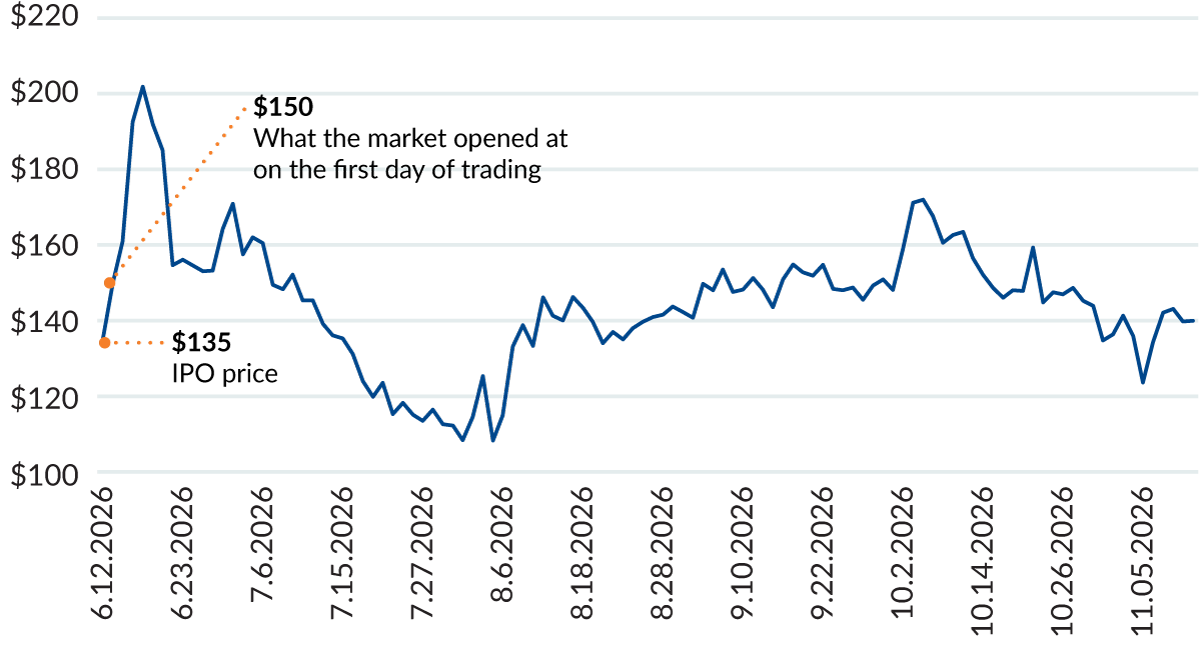
To give a recent example, SpaceX offered shares at an IPO price of $135. The market opened for trading at $150 and the price at the end of the first day was $161. In the weeks that followed, the stock rose to over $200, fell to $104 and now sits within $5 of its offering price as of the time of writing. In the short time this stock has been trading, its peak-to-trough decline was -46%. An investor who purchased open market shares on the day of the IPO is currently saddled with an unrealized loss.1
The IPO market has experienced dramatic cycles as interest rates, economic conditions and technological advancements can influence how many companies go public, as seen in the chart below:
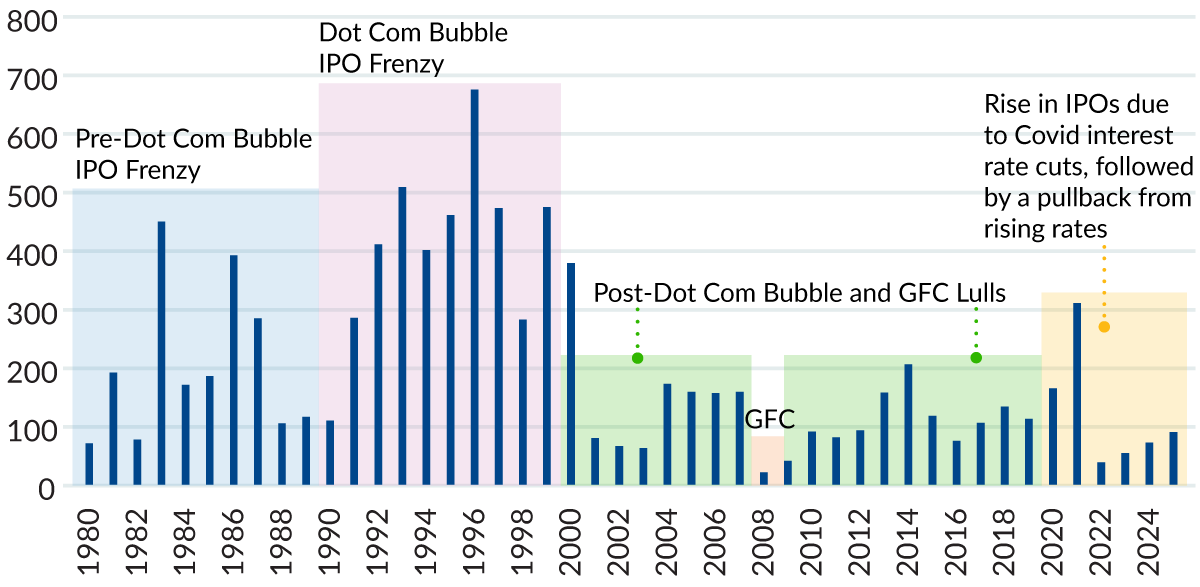
One important takeaway is that companies often come to market when investor appetite is strong. The number of IPOs and the amount of capital raised can reveal a great deal about market sentiment, but elevated activity is not, on its own, a signal of attractive future returns.
From 1980 through 2025, US IPOs generated an average first day return of approximately 19%, measured from the offering price to the first closing price. Those gains can attract headlines, but they do not represent the experience of an investor who buys after trading has already begun. Market buyers may pay a substantial premium to the offering price, particularly when demand for a high-profile listing exceeds the shares available for sale.2
The challenge is that expectations embedded in the share price can change quickly. A newly public company might deliver strong revenue growth and still disappoint shareholders if that growth falls short of what investors had already anticipated.
Volatility is a measure that describes how much a stock's price fluctuates. Volatility is felt during a market drawdown, which captures the decline from a prior peak to a subsequent low. Among 1,494 IPOs that raised at least $50 million between April 1995 and April 2025, the average maximum drawdown during the first year was 48.9%. Only 40.6% of those IPOs outperformed the S&P 500 over their first year of public trading.3
A drawdown is not the same as realized loss, as a stock may recover some or all of its decline. Nevertheless, a sizable temporary decline can be difficult to withstand, particularly for investors who made a concentrated purchase shortly after an IPO.
Longer-term history presents a similarly wide range of outcomes. For 9,195 US IPOs from 1975 through 2021, cumulative returns measured from the first day's closing price to the three-year anniversary or earlier delisting averaged a positive 21.2%, while the median was negative 25.7%. Approximately 60% generated returns of zero or less, including 38.5% that lost more than half their value.4
At the other extreme, roughly 16% more than doubled in value. The large gap between the average and median demonstrates how extraordinary winners can raise the average return even when the typical investment result is much weaker.
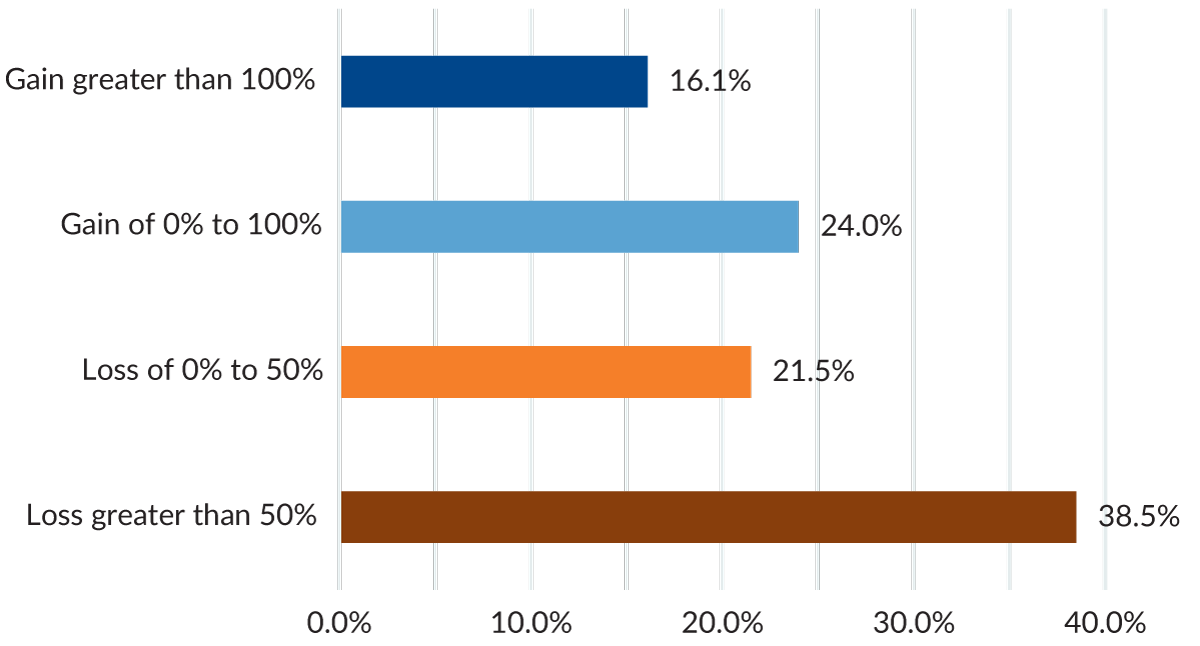
Returns include dividends and end at the three-year anniversary or earlier delisting, with a December 31, 2025 data cutoff.4
This does not mean IPO investing is inherently unattractive. Some newly public companies ultimately become exceptional long-term investments. The difficulty is identifying those businesses in advance and avoiding a purchase price that already assumes unusually favorable outcomes.
Mesirow clients might get exposure to IPOs through a fund or through a private investment vehicle. We do not generally provide IPO access directly. If you are considering purchasing a post-IPO company on the open market, consider the following with your Wealth Advisor:
1. Understand the price, not just the company
A recognizable brand, promising technology or compelling growth story does not establish what a share of the business is worth. Investors should examine financial results, competitive pressures, profitability prospects and the assumptions required to justify the current valuation. An IPO's offering price, an analyst's fair value estimate and its market trading price are different measures that should not be confused.
2. Be prepared for a wide range of outcomes
Newly public companies may have limited histories of public reporting, concentrated ownership and rapidly changing expectations. Prices can react sharply to earnings announcements, industry developments or the expiration of insider lockup periods. Investors should consider whether they could tolerate meaningful losses without disrupting their long-term financial plan.
3. Keep individual opportunities in the context of a diversified portfolio
Investors do not necessarily need to purchase a stock on its first day to participate in a company's future growth. Newly public companies may eventually become holdings in diversified mutual funds and ETFs, depending on the fund's investment mandate and, for index funds, the index's inclusion rules. Private investments can provide earlier access in some cases, but introduce different liquidity, valuation and fee considerations.
Ultimately, going public is an important milestone for a company, not an automatic signal to purchase its stock. Staying focused on valuation, diversification and financial objective scan help investors stay the course to achieve their long-term financial goals.
Consult with a Mesirow Wealth Advisor to determine how any individual investment may fit within your overall portfolio.
Mesirow does not provide legal or tax advice. Past performance is not indicative of future results. The views expressed above are as of the date given, may change as market or other conditions change, and may differ from views express by other Mesirow associates. This is not a solicitation to buy or sell the securities mentioned. Do not use this information as the sole basis for investment decisions, it is not intended as advice designed to meet the particular needs of an individual investor. Information herein has been obtained from sources which Mesirow believes to be reliable, we do not guarantee its accuracy and such information may be incomplete and/or condensed. All opinions and estimates included herein are subject to change without notice. This communication may contain privileged and/or confidential information. It is intended solely for the use of the addressee. If you are not the intended recipient, you are strictly prohibited from disclosing, copying, distributing or using any of the information. If you receive this communication in error, please contact the sender immediately and destroy the material in its entirety, whether electronic or hard copy. This material is for informational purposes only and is not intended as an offer or solicitation with respect to the purchase or sale of any security.
Mesirow Wealth Management is a division of Mesirow Financial Investment Management, Inc., an SEC-registered investment advisor. Securities offered through Mesirow Financial, Inc., member FINRA, SIPC. Advisory Fees are described in Mesirow Financial Investment Management Inc.’s Part 2A of the Form ADV.